


Alemnis Standard Assembly Integration in Vacuum Chamber
Many advanced materials require nanomechanical testing under controlled environmental conditions. Integrating the Alemnis Standard Assembly (ASA) into the vacuum chamber provides a versatile platform for mechanical characterization in tailored gaseous and vacuum environments. This configuration enables correlation of environmental conditions with mechanical response across controlled gas, vacuum, cryogenic, room-temperature, and high-temperature testing conditions, while maintaining a compact, modular, and highly adaptable experimental workflow.
- Vacuum and controlled gas testing down to < 5 × 10⁻⁷ mbar
- HTM/LTM compatible with cooling water and LN₂ connections
- Customizable integration with feedthroughs, flanges, and gas lines
- Integrated ASA for stable in situ nanomechanical testing

Application Examples
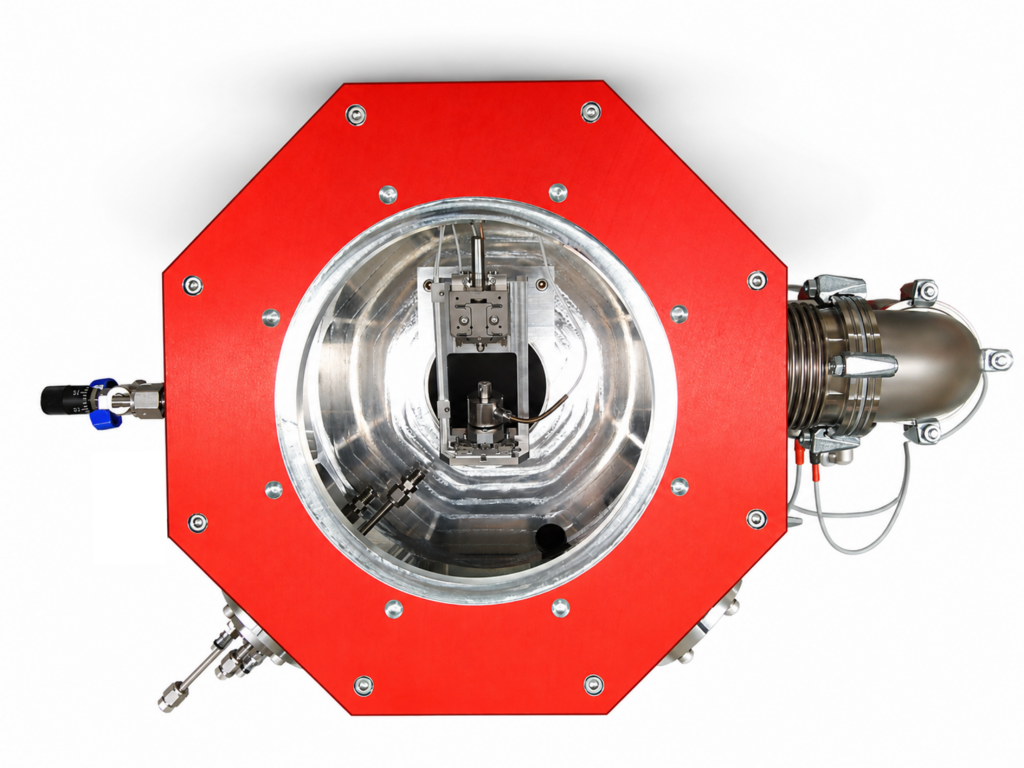
Vaccum chamber platform for in situ nanomechanical testing under controlled vacuum and gas environments.
ATSI: Automated Temperature Sweep Indentations
Combining the vacuum chamber with the Alemnis ASA enables automated nanoindentation across a wide temperature range under vacuum or controlled gas environments. This allows direct measurement of hardness, modulus, and deformation behavior as a function of temperature while minimizing oxidation and environmental effects.
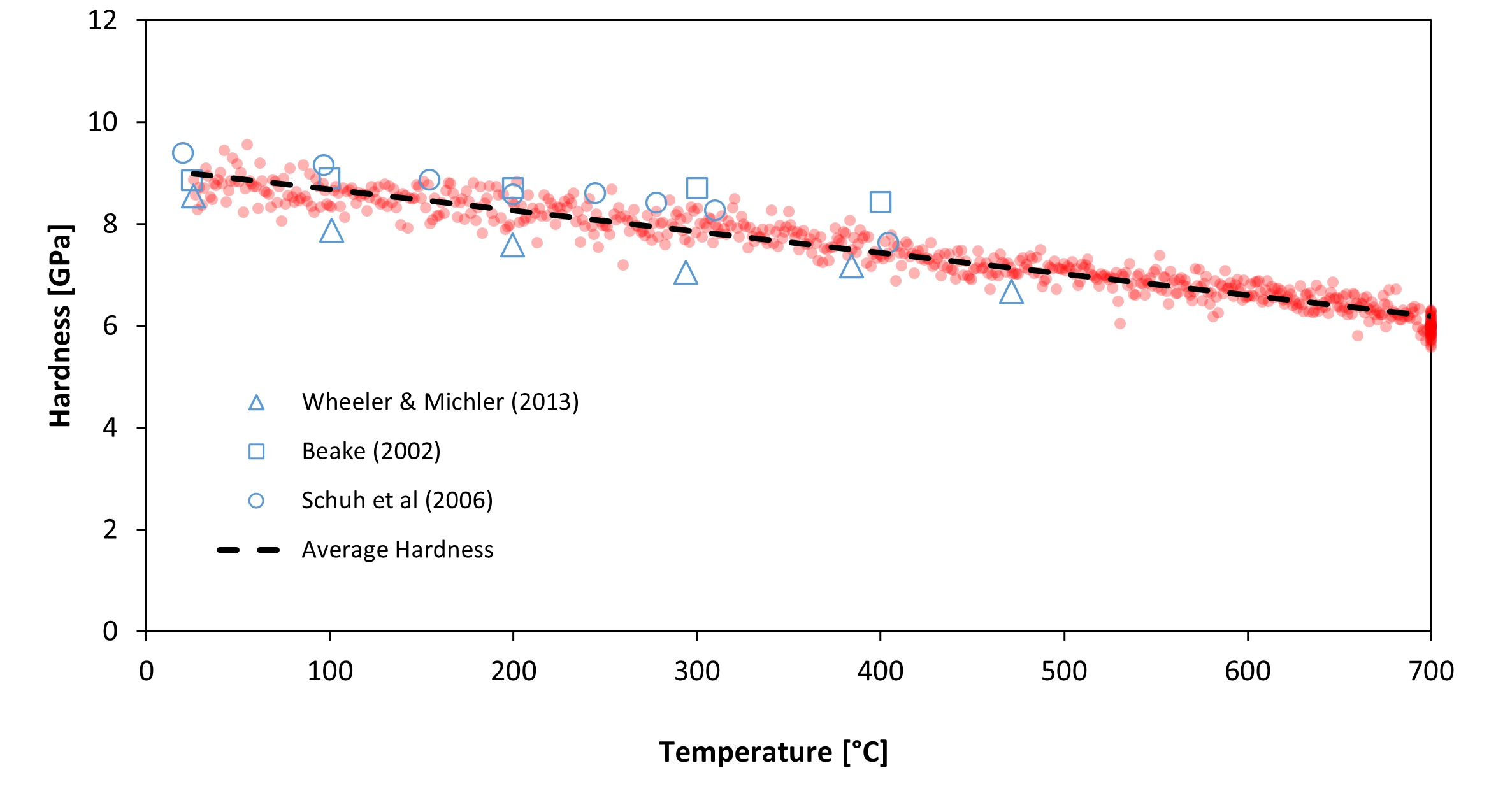
Determining high temperature mechanical properties becomes extremely efficient using Alemnis’ novel Automated Temperature Sweep Indentation method. Continuous (fast) indents were performed automatically during a temperature ramp of 7 °C/minute.
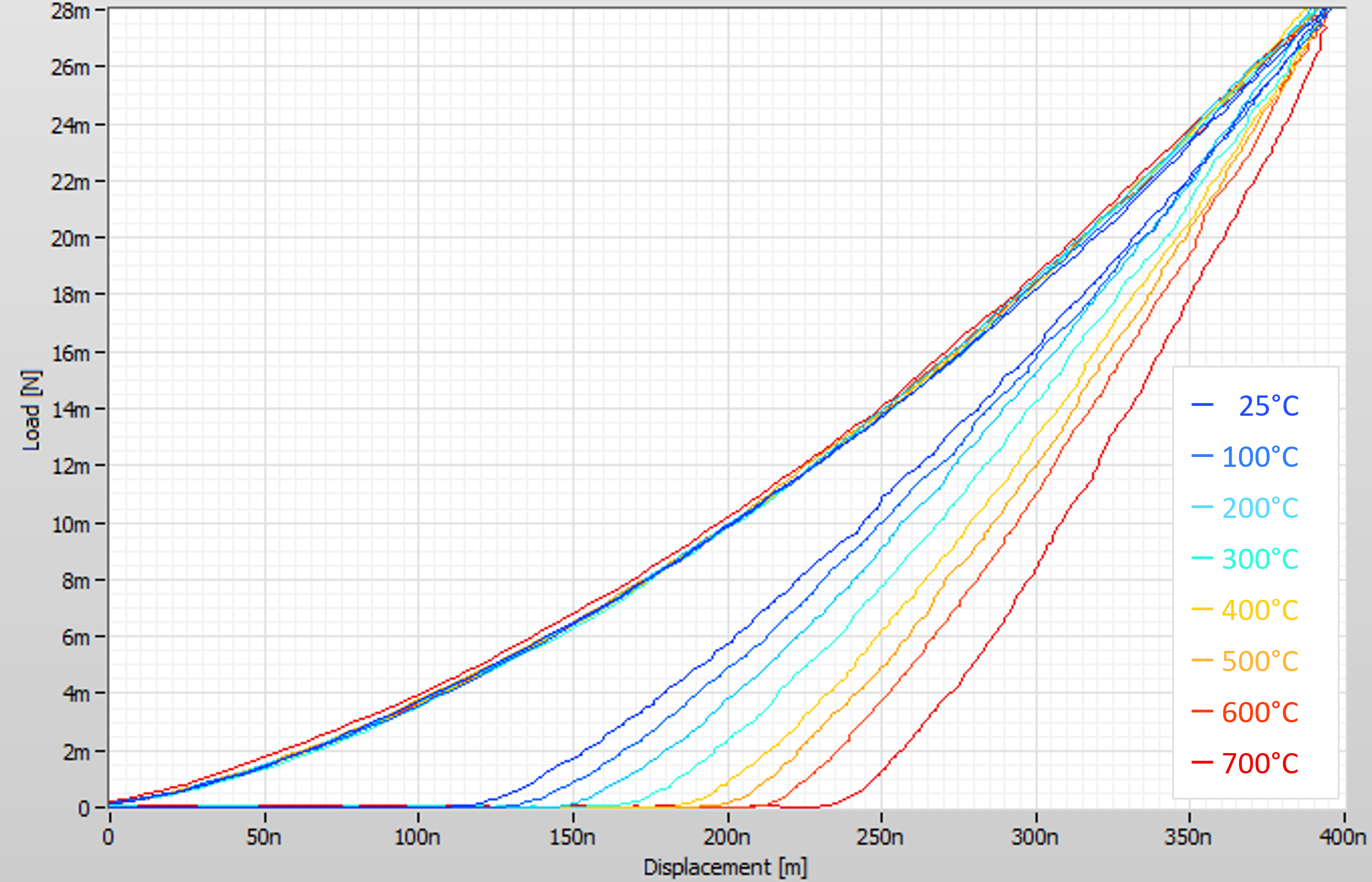
Representative load-displacement curves from Automated Temperature Sweep Indentation experiment on fused silica.
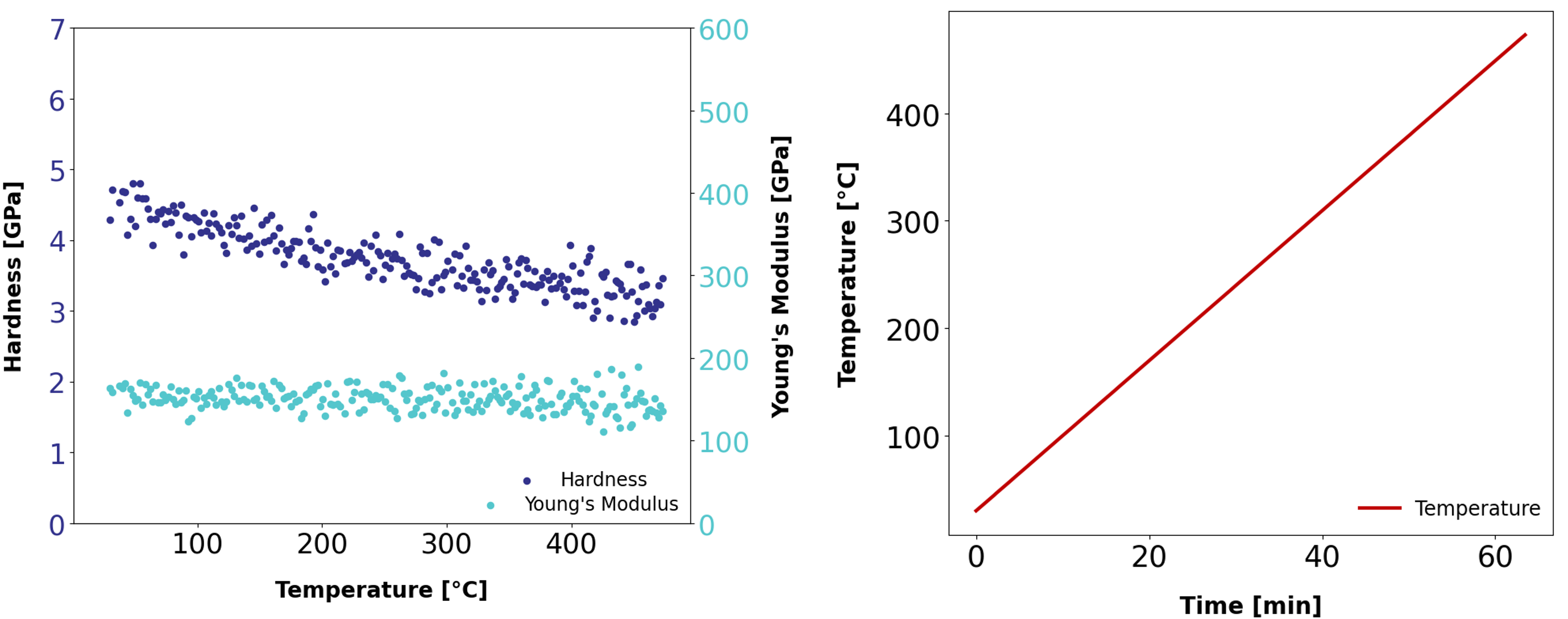
High temperature indentation hardness and elastic modulus of pure uranium obtained by Alemnis’ Automated Temperature Sweep Indentation method.
Correlative Mechanical Mapping
The integrated ASA can perform high-resolution mechanical property mapping inside the vacuum chamber, allowing local hardness, modulus, and deformation behavior to be correlated with microstructural or imaging data. Controlled vacuum and gas conditions help isolate environmental influences and improve the relevance of structure–property relationships.

Correlative mechanical property map overlaid on the material microstructure, revealing local variations in mechanical response.
Hydrogen–Hardness Correlation Mapping
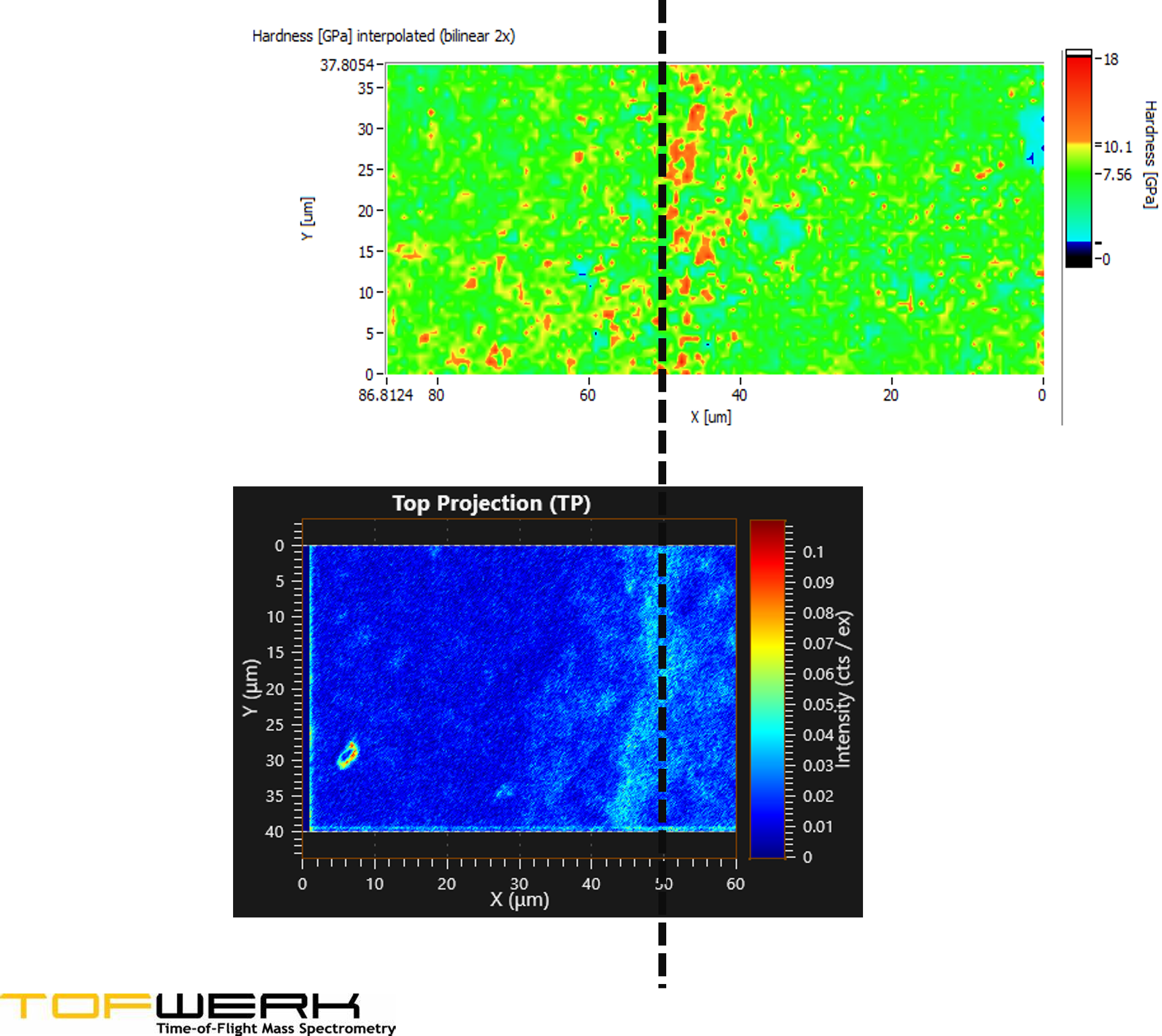
Correlative mechanical and chemical mapping: Hardness distribution from nanoindentation (top) compared with the corresponding ToF-SIMS chemical map (bottom). The dashed line indicates the aligned reference position between the two datasets.
Shallow Indentation for Semiconductor Mechanical Characterization

Low-depth nanoindentation resolving nanoscale pop-in events in semiconductor materials.