


Air Sensitive Materials Testing
Many advanced materials and devices are highly sensitive to environmental exposure during sample preparation and characterization. Oxidation, moisture adsorption, or contamination can rapidly alter surface chemistry and microstructure, leading to inaccurate experimental results. The Vacuum Transfer Module (VTM) enables safe and controlled transfer of samples between preparation systems and characterization instruments while maintaining a protected environment. By preserving either vacuum or a controlled gas atmosphere, the VTM ensures that sensitive samples remain stable during transport and handling. Once the sample is safely transferred into the SEM chamber, the VTM can be opened and the specimen can be directly accessed for in-situ nanomechanical testing, such as nanoindentation, without exposing it to ambient air.
Key Advantages:
- Preserves sample environment during transfer between instruments
- Maintains vacuum or controlled gas atmosphere for sensitive materials
- Protects air-sensitive and reactive samples from oxidation and contamination
- Compatible with SEM and vacuum-based systems
- Compact and easy to handle for laboratory workflows
- Reliable sealing performance

SEM/FIB Preparation of Air-Sensitive Materials
This workflow was implemented in collaboration with EMPA. After transferring an air-sensitive specimen directly from a glove box, the sample remains sealed from ambient exposure while positioned in a rigid holder that provides unobstructed access for both the electron beam and the ion column. The compact size of the VTM ensures compatibility with the SEM stage movement, allowing full rotation and tilt without mechanical interference and enabling immediate imaging and localization of the region of interest without altering the native surface condition.
The required orientation for FIB processing is achieved using the SEM stage rotation and tilt to reach the typical milling geometry of approximately 52–60°, enabling efficient material removal and final polishing. Coarse trenching can be performed at the standard incidence angle, followed by gentle polishing at higher angles to minimize curtaining and ion-beam damage. Because the sample stays inside the protected transfer environment throughout alignment, milling, and polishing, oxidation, hydration, or contamination artefacts are avoided, ensuring that the prepared cross-section accurately represents the original microstructure.
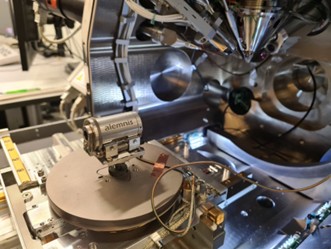
Vacuum Transfer Module (VTM) mounted inside the SEM chamber after protected transfer from a controlled environment.
(courtesy of Empa Dübendorf)

Sample rotated to ~60° for final FIB polishing and low-damage cross-section preparation. (courtesy of Empa Dübendorf)
In the study Cr-LiF as a High Energy Density Conversion-Type Cathode for Li-ion Solid-State Batteries, detailed microstructural and chemical analysis was essential to understand the phase evolution and interfacial processes occurring during cycling [1]. The thin-film Cr–LiF cathode and full solid-state stack were investigated by advanced TEM and STEM-EELS techniques to identify the dominant CrF₂ phase formation, nanoscale segregation, and long-term structural restructuring.
To enable this level of analysis, TEM lamellae were prepared using a FIB lift-out workflow with air-free transfer, ensuring that the highly reactive cathode materials were preserved in their true electrochemical condition. Controlled preparation and protected transfer are particularly important for conversion-type and solid-state battery materials, where exposure to air can alter surface chemistry and interfacial phases. Such an approach allows reliable nanoscale characterization of phase transformations and degradation mechanisms in air-sensitive energy storage systems.
In-Situ Mechanical Testing of Air-Sensitive Materials Using Protected Transfer
Air-sensitive materials can be prepared inside a controlled environment, sealed within the Vacuum Transfer Module (VTM), and transferred directly into the SEM for mechanical testing without exposure to ambient atmosphere. Once inside the chamber, compression or indentation experiments can be performed immediately on the protected specimen, enabling quantitative measurement of mechanic properties such as elastic-plastic behavior, fracture, creep, or time-dependent deformation in the unexposed state. This is particularly important for materials whose mechanical response rapidly changes after only seconds of air exposure, such as soft electrodes, reactive metals, or hygroscopic compounds.
The protected workflow expands the reliability of several research and industrial applications. In Li-ion battery research, electrodes, solid electrolytes, and lithium metal can be characterized without artificial surface layers forming during transfer, allowing meaningful correlation between microstructure and electrochemical performance. In the pharmaceutical field, powders and porous tablets sensitive to humidity can be mechanically evaluated while preserving their real structure and cohesion. For nuclear materials, oxidation-sensitive alloys or irradiated specimens can be handled more safely and analyzed with reduced alteration of the surface chemistry. Across all these areas, the VTM prevents oxidation, hydration, and contamination, ensuring that deformation mechanisms, cracking behavior, and mechanical properties reflect the actual material condition rather than environmental artefacts.
In situ nanoindentation of an air-sensitive material performed inside a scanning electron microscope (SEM) using the vacuum transfer module (VTM). The VTM enables sample transfer from a controlled environment to the SEM without air exposure, allowing reliable micromechanical testing of environmentally sensitive materials.
Selected Application Examples
Protected In-Situ Electrical Probing of Air-Sensitive Materials Using VTM and miBot in SEM
Alemnis collaborated with Imina Technologies to integrate the Vacuum Transfer Module (VTM) with miBot nanomanipulators inside the SEM, enabling handling and probing of highly air-sensitive materials without atmospheric exposure. Samples are transferred directly from a controlled environment into the microscope using the VTM, after which the mobile miBot probes can be positioned on the specimen for electrical contacting, device characterization, or micro-manipulation. This combined workflow preserves the native surface chemistry while allowing precise in-situ measurements, making it particularly suitable for reactive materials such as battery components, thin films, and 2D materials where both environmental protection and accurate probing are essential.
To learn more about the Alemnis Mechanical Electrical Probe (MEP), visit the MEP product page
Advanced Characterization of Degradation Mechanisms in Ni-Rich Battery Cathodes
Understanding how Ni-rich NMC811 cathode particles degrade mechanically during electrochemical cycling is critical for advancing lithium-ion battery durability and safety [3]. By combining electrochemical conditioning with in situ SEM micromechanical testing, researchers can directly observe crack initiation, intergranular fracture, and strength evolution at the level of individual secondary particles. These studies demonstrate that delithiation induces significant weakening due to anisotropic lattice changes, internal strain accumulation, and phase transformations, while relithiation leads only to partial mechanical recovery. Continued cycling further promotes irreversible cracking and structural damage, directly linking electrochemical history to mechanical stability and long-term capacity fade.
Research that integrates electrochemistry with high-resolution mechanical characterization provides a quantitative framework for correlating electrochemical state, microstructure, and fracture behaviour. Because highly delithiated Ni-rich cathodes are chemically reactive and susceptible to surface modification upon air exposure, maintaining controlled handling conditions is scientifically important to ensure accurate interpretation of intrinsic mechanical properties. As investigations increasingly focus on degradation mechanisms at the particle scale, environmentally controlled and vacuum-based transfer solutions become highly valuable tools to support reliable and reproducible characterization of sensitive battery materials.

Video sequence of in situ SEM images showing compression of a pristine NMC811 particle, together with the corresponding load–indenter displacement curve evolution [3].
Selected References
- Casella, J.; Morzy, J.; Montanelli, V.; Mocanu, F.C.; Müller, A.; Futscher, M.H.; Rossell, M.D.; Islam, M.S.; Yarema, M.; Romanyuk, Y., Cr-LiF as a High Energy Density Conversion-Type Cathode for Li-ion Solid-State Batteries, Communications Materials 7 (2026) 113. https://doi.org/10.1038/s43246-026-01121-0
- Wang; Z. Shen; A. Omirkhan; O. Gavalda-Diaz; M. P. Ryan; F. Giuliani, Determining the fundamental failure modes in Ni-rich lithium ion battery cathodes, Journal of the European Ceramic Society 43 (2023) 7553–7560. https://doi.org/10.1016/j.jeurceramsoc.2023.08.021
- Omirkhan; O. Gavalda-Diaz; S. Wang; I. E. Stephens; F. Giuliani; M. P. Ryan, Investigating the effect of lithiation on polycrystalline NMC811 Li-ion battery cathode cracking using in situ SEM micromechanical testing, Energy & Environmental Science 18 (2025) 9254–9262. https://doi.org/10.1039/d5ee00976f