


Vacuum Transfer Module (VTM)
The Alemnis Standard Assembly (ASA) was developed with versatility as a core principle. The Vacuum Transfer Module (VTM) is an accessory module that expands this flexibility, enabling a safe work flow for air sensitive samples.
The VTM can be used as an independent transfer and handling platform for materials that rapidly degrade upon atmospheric exposure, such as battery electrodes, catalysts, alkali metals, and moisture-reactive alloys. Samples are sealed inside a controlled environment, transported directly into the SEM, and remain protected during imaging or FIB milling. This enables reliable morphology observation, cross-section preparation, and site-specific analysis without oxidation or contamination, preserving the true microstructure for accurate characterization.
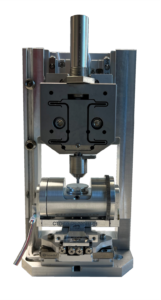
Compact and Retrofittable
The Alemnis Vacuum Transfer Module (VTM) is the most compact solution to shuttle air and humidity sensitive samples from a glove box to a SEM and back. A simple and robust design allows it to be fixed on the Alemnis Standard Assembly (ASA) without modification. The VTM can also be used alone without the nanoindenter to perform standard imaging or FIB cutting tasks of sensitive materials.
Working Principle
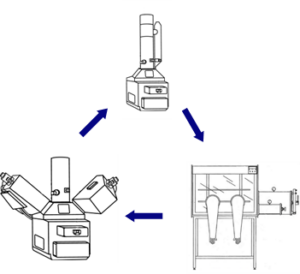
The Vacuum Transfer Module has approximate dimensions (L x W x H) of 60 x 40 x 40 mm and a total weight of 53g. A sliding dovetail fitting allows quick mounting of the module on the Alemnis Indenter or directly on the Stage of an SEM or FIB. To open and close the drum-type mechanism, the unit ships with two battery powered controllers. One can be kept in a glovebox, while the other is used on the SEM via standard vacuum-feedthrough.
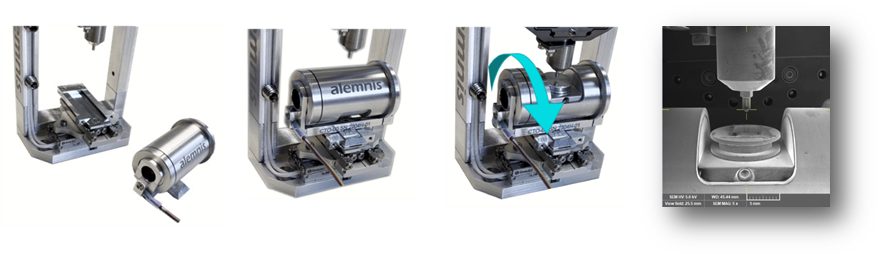
Vacuum Transfer Module (VTM) in action. The video (left) shows the straightforward integration of the VTM with the ASA system. The video (right) demonstrates protected sample transfer from a glovebox to the SEM, enabling in-situ nanoindentation without exposure to air.
Controlled Sealing Mechanism
The Vacuum Transfer Module (VTM) features a simple, user-friendly mechanism and can be easily installed onto the Alemnis Standard Assembly (ASA) without modification. During closure, a clearly defined mechanical stop is reached, providing tactile feedback that the sealing position has been achieved. This ensures reproducible sealing force independent of the user and prevents over-tightening.
The controlled stop guarantees consistent vacuum performance and reliable operation across repeated transfers, allowing users to handle sensitive samples confidently without requiring specialized training or adjustment.
VTM Pressure Stability Tests
To evaluate the sealing performance and environmental stability of the Vacuum Transfer Module (VTM), two complementary tests were performed. The first test investigates the behavior of an evacuated VTM when exposed to ambient air, while the second test examines the ability of the VTM to retain gas when placed in a high-vacuum environment similar to that of a scanning electron microscope (SEM). Together, these experiments demonstrate the effectiveness of the VTM in maintaining controlled environments during sample transfer between air and vacuum conditions.
Performance of the VTM in SEM Vacuum
In the first test, the VTM was filled with gas at near-atmospheric pressure and then placed in a high-vacuum environment representative of an SEM chamber. The internal pressure was monitored for more than 20 hours to evaluate gas retention and leak tightness. The measurements show that the pressure inside the VTM remains highly stable with only a minimal decrease over time, indicating negligible gas leakage into the surrounding vacuum. This confirms that the VTM effectively preserves the internal atmosphere, enabling safe transfer of air-sensitive or environmentally controlled samples into SEM vacuum conditions.

VTM atmosphere retention in SEM vacuum (20-Hour Test)
Performance of the VTM in Air
In the second test, the VTM was initially evacuated and then exposed to ambient air while the internal pressure was monitored over time. The pressure stabilizes at a vacuum level and remains steady for a minimum of one hour, demonstrating the excellent sealing capability of the VTM and its ability to maintain a vacuum suitable for transfer, ensuring reliable protection of sensitive samples during handling.
Learn how the Vacuum Transfer Module enables safe sample transfer and controlled in-situ nanoindentation experiments inside the SEM.